IPTV vs Streaming Services: What’s the Difference in 2026?
The way people watch television has changed dramatically over the last few years.
Traditional cable and satellite TV are no longer the only options. Today, viewers can choose from IPTV services, subscription streaming platforms, free ad-supported services, live TV platforms, and on-demand video libraries.
Two of the most commonly compared options are IPTV and traditional streaming services.
Although both deliver video over an internet connection, they are not exactly the same.
IPTV typically focuses on delivering television channels and live programming over IP networks, while mainstream streaming services often focus heavily on on-demand movies, series, documentaries, and original productions.
In 2026, the difference can be less obvious because many modern services combine live television and on-demand content.
This guide explains the main differences so you can understand which approach may suit your viewing habits.
Only use IPTV services and content that you are authorized to access.
IPTV versus traditional streaming services comparison
What Is IPTV?
IPTV stands for Internet Protocol Television.
Instead of receiving television through traditional terrestrial, satellite, or cable infrastructure, IPTV delivers television content through an internet protocol network.
Depending on the service, IPTV can provide:
- Live television channels
- Sports programming
- News channels
- Entertainment channels
- International television
- Video-on-demand content
- Catch-up television
- Electronic program guides
The exact features depend on the provider and service.
IPTV can be accessed through compatible Smart TVs, streaming boxes, Android TV devices, computers, smartphones, tablets, and other supported hardware.
What Are Streaming Services?
Streaming services are platforms that deliver video content over the internet without requiring viewers to download an entire video before watching it.
Examples of mainstream streaming models include services focused primarily on:
- Movies
- TV series
- Original productions
- Documentaries
- Children's programming
- Live events
- On-demand libraries
Unlike traditional television, viewers can generally start watching content whenever they want.
Many streaming services use subscription plans, while some use advertising-supported models.
How Are IPTV and Streaming Services Similar?
Despite their differences, IPTV and streaming platforms have several things in common.
Both generally require:
- An internet connection
- A compatible device
- A video application or player
- A content source
- Sufficient bandwidth for the selected quality
Both can also support high-definition and, where available, 4K video.
Both have moved television away from fixed broadcast schedules toward internet-based viewing.
The biggest difference is usually the type and organization of content, rather than the basic idea of delivering video over the internet.
IPTV vs Streaming Services: Main Differences
| Feature | IPTV | Traditional Streaming Services |
|---|---|---|
| Main focus | Live TV and television channels | On-demand movies and series |
| Live channels | Common | Depends on the service |
| On-demand content | Often available | Core feature for many platforms |
| Channel-style experience | Common | Less common |
| Electronic Program Guide | Often available | Usually not central |
| Internet required | Yes | Yes |
| Compatible devices | TVs, boxes, phones, tablets, computers | TVs, boxes, phones, tablets, computers |
| Content library | Depends on provider | Depends on platform |
| Original productions | Provider-dependent | Common on major platforms |
| Pricing | Varies by service | Usually subscription-based |
| Viewing flexibility | High | High |
| User experience | Often TV-oriented | Often library-oriented |
The table provides a general comparison. Features vary significantly between individual services.
1. Live TV vs On-Demand Viewing
One of the biggest differences is how content is presented.
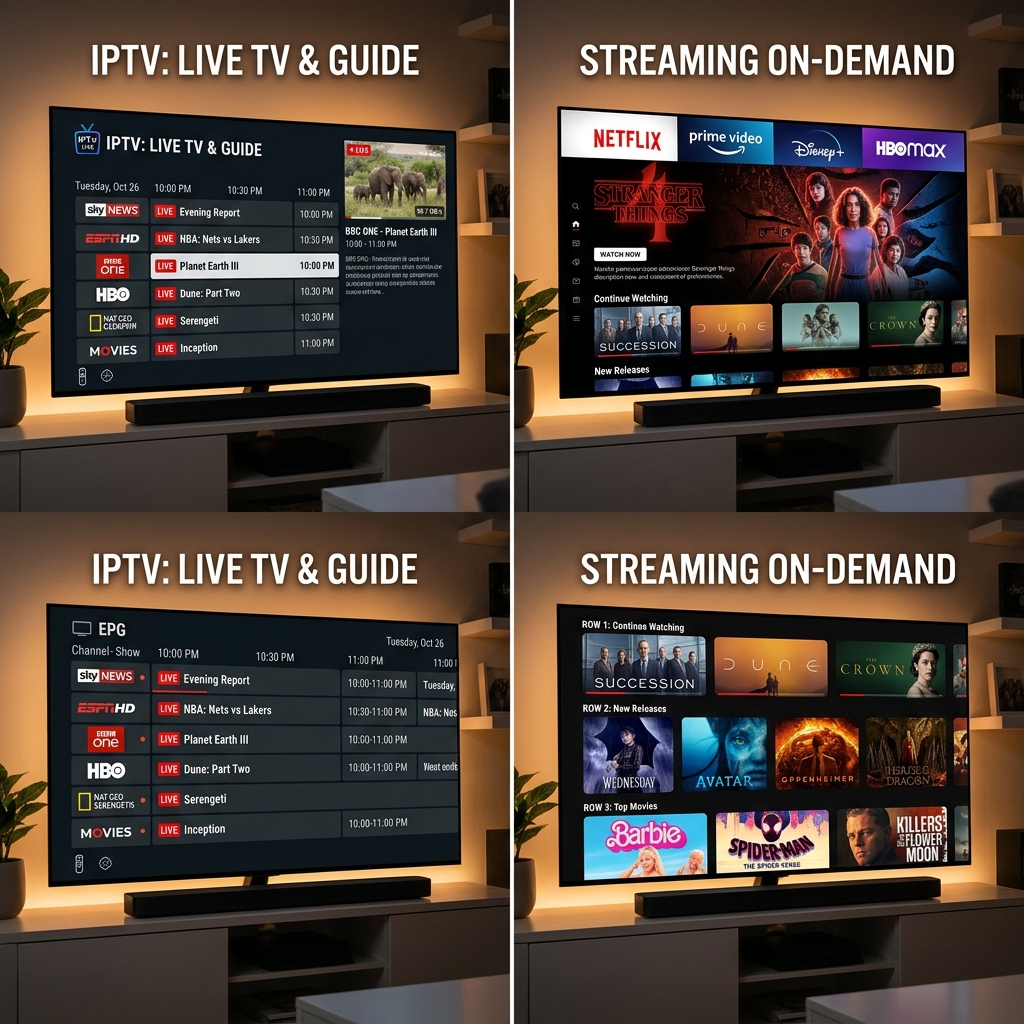
IPTV is often designed around the traditional television experience.
You may open a channel list, select a channel, and watch whatever is currently broadcasting.
Streaming platforms traditionally emphasize on-demand viewing.
Instead of asking "What is currently on?", viewers choose a movie or series from a library and start it whenever they want.
However, this distinction is becoming less absolute.
Many modern streaming platforms now offer live channels, news, sports, and other real-time programming. However, if your live feeds aren't working, you might want to look into why your IPTV channels are not loading.
2. Channel Selection
IPTV can provide a channel-oriented experience.
Depending on the authorized service, users may have access to different categories such as:
- News
- Sports
- Movies
- Entertainment
- Kids
- International channels
Traditional on-demand streaming platforms generally organize content by:
- Movies
- TV shows
- Genres
- Recommendations
- New releases
- Original productions
If you prefer browsing television channels like traditional cable, IPTV may feel more familiar.
If you prefer selecting individual movies and episodes, an on-demand streaming platform may feel more natural.
3. Electronic Program Guides
An Electronic Program Guide, commonly called an EPG, is an important feature of many IPTV systems.
It can show:
- Current programs
- Upcoming programs
- Program times
- Channel information
- Program descriptions
This creates a television-like experience.
Many traditional on-demand streaming services do not rely on an EPG because users are selecting individual titles instead of browsing a live channel schedule.
4. On-Demand Content
Both IPTV services and streaming platforms can offer on-demand content.
However, the organization can be different.
An IPTV service may combine live channels and an on-demand section.
A traditional streaming platform usually builds its entire experience around an on-demand library.
The better option depends on whether you primarily watch live television or choose individual programs.
5. Sports and Live Events
Live sports are one area where the difference between IPTV and on-demand streaming becomes especially interesting.
Live television services can be convenient for viewers who want to follow:
- Football
- Basketball
- Tennis
- Motorsports
- News events
- Other live programming
However, the availability of specific sports depends on broadcasting rights and the country where you are located.
A streaming platform may also offer live sports, but availability varies considerably between services.
Always check whether a service is officially licensed to provide the content you want to watch.
6. Video Quality
Both IPTV and streaming services can support high-quality video.
Depending on the platform, viewers may encounter:
- HD
- Full HD
- 4K
- HDR
Actual quality depends on several factors, including:
- Source quality
- Encoding
- Device capabilities
- Internet connection
- Network congestion
- Display
A service advertising 4K does not automatically guarantee that every piece of content will be delivered in native 4K.
7. Internet Requirements
Both IPTV and streaming platforms depend on a reliable internet connection.
The required bandwidth varies depending on:
- Video resolution
- Compression
- Bitrate
- Frame rate
- Network conditions
Higher-quality video generally requires more bandwidth.
However, speed is not the only factor.
A stable connection with low packet loss and consistent latency can provide a better experience than a faster but unstable connection.
8. Device Compatibility
Modern IPTV and streaming services support many different devices.
Common options include:
The exact compatibility depends on the service and application.
Before choosing a platform, verify that it supports the device you already own.
9. User Experience
The user experience can feel quite different.
IPTV often resembles traditional television:
Open app → browse channels → select channel → watch.
On-demand streaming usually feels more like a digital media library:
Open app → browse categories → select movie or series → watch.
Neither approach is automatically better.
It depends on how you prefer to consume content.
10. Content Discovery
Streaming platforms often use recommendation systems to suggest movies and series.
These recommendations can be based on:
- Viewing history
- Genres
- Ratings
- Similar titles
- Popularity
IPTV applications may instead prioritize channel lists and categories.
Some IPTV platforms also offer search, favorites, EPG data, and on-demand libraries.
11. Pricing
Pricing varies widely across both categories.
Traditional streaming services often use several subscription tiers.
An IPTV service may use different pricing structures depending on its features, channel selection, duration, and supported devices.
When comparing prices, do not look only at the monthly fee.
Consider:
- Number of supported devices
- Live channels
- On-demand content
- Video quality
- Simultaneous streams
- EPG availability
- Catch-up features
- Customer support
Most importantly, make sure the service legally provides the content it offers in your region.
12. Flexibility
Both IPTV and streaming services can be flexible compared with traditional television.
You can often watch from multiple devices and locations, subject to the provider's terms.
IPTV can be particularly flexible for users who want a mixture of live channels and on-demand content.
Traditional streaming platforms can be particularly convenient for users who primarily watch movies and series whenever they choose.
13. Content Availability Depends on Location
One important factor is geographical availability.
Licensing agreements can determine which movies, series, sports events, or television channels are available in a particular country.
A service that offers certain content in one region may not offer the same catalog elsewhere.
This applies to both IPTV and traditional streaming platforms.
Always check the official availability information for your location.
14. Legal and Licensing Considerations
This is an important distinction that should not be ignored.
IPTV itself is a technology, not inherently an illegal service.
The legality depends on how the service obtains and distributes the content.
There are legitimate IPTV services operated by broadcasters, telecommunications companies, television networks, and licensed providers.
There are also unauthorized services that distribute copyrighted channels or content without permission.
When choosing an IPTV service, make sure it has the appropriate rights to provide the content in your region.
The same principle applies to streaming platforms: legitimate platforms operate under licensing agreements or own the rights to the content they distribute.
IPTV vs Streaming Services: Advantages and Disadvantages
IPTV Advantages
- Strong focus on live television
- Channel-based viewing experience
- EPG support on many services
- Can combine live and on-demand content
- Useful for viewers who prefer traditional TV navigation
- Supports many modern streaming devices
IPTV Disadvantages
- Features vary significantly between providers
- Quality can depend heavily on the service infrastructure
- Some services may have limited device compatibility
- Content availability depends on licensing
- Users need to carefully verify provider legitimacy
Streaming Service Advantages
- Large on-demand libraries
- Easy movie and series discovery
- Strong recommendation systems
- Professional applications
- Consistent user interfaces
- Many original productions
- Wide device support
Streaming Service Disadvantages
- Content is divided between different platforms
- Live television may be limited depending on the service
- Sports availability varies
- Multiple subscriptions can become expensive
- Catalogs can change over time
Which Is Better in 2026?
There is no single answer.
The better option depends on what you watch.
Choose IPTV if you primarily want:
- Live television
- Channel-based viewing
- International channels
- EPG functionality
- A traditional TV-style experience
- A mixture of live and on-demand content
Choose traditional streaming services if you primarily want:
- Movies
- TV series
- Original productions
- On-demand viewing
- Personalized recommendations
- Simple library-based browsing
Consider using both
Many viewers do not have to choose only one.
You can use a legitimate IPTV service for live television while using separate streaming platforms for movies and series.
This approach can provide access to different types of content without expecting one service to do everything.
What Should You Check Before Choosing an IPTV Service?
If you decide IPTV is more suitable for you, evaluate the service carefully.
Check:
- Whether the provider is legitimate.
- Whether it has the necessary content rights.
- Supported devices.
- Video quality.
- Live channel selection.
- On-demand options.
- EPG availability.
- Customer support.
- Account and device limits.
- Pricing and subscription terms.
Do not choose a service based solely on the number of channels advertised.
Quality, reliability, legality, and device compatibility are much more important.
Frequently Asked Questions
Is IPTV the same as Netflix?
No. IPTV is a method of delivering television over IP networks and often emphasizes live channels, while Netflix is an on-demand streaming platform. The two technologies and content models are different.
Is IPTV better than streaming services?
It depends on what you watch. IPTV can be better for live television and channel-based viewing, while traditional streaming platforms can be better for movies, series, and on-demand content.
Does IPTV require internet?
IPTV delivered through internet-based services generally requires an internet connection. The required quality depends on the video resolution and service.
Can IPTV provide 4K?
Yes, some legitimate IPTV services can provide 4K content when the source, service, device, display, and network support it.
Can I watch IPTV on a Smart TV?
Many IPTV services and compatible players support Smart TVs, but compatibility depends on the specific television model, operating system, application, and provider.
Is IPTV legal?
IPTV technology is legal. The important issue is whether the provider has the appropriate rights to distribute the content it offers.
Why do streaming services have different content in different countries?
Licensing agreements often vary by region, which means the same platform may have different catalogs depending on the country.
Can IPTV replace cable TV?
For some viewers, yes. IPTV can provide a similar live-channel experience through an internet connection, although the available channels and features depend on the legitimate service.
Do I need multiple streaming services?
Not necessarily, but many viewers use multiple services because different platforms have different content libraries and exclusive programs.
Conclusion
IPTV and traditional streaming services both use the internet to deliver video, but they are designed around different viewing experiences.
IPTV often focuses on live television, channel browsing, EPGs, and a traditional TV-style experience, while mainstream streaming platforms tend to emphasize on-demand movies, series, recommendations, and original productions.
In 2026, the distinction is becoming less rigid as more platforms combine live and on-demand content.
The right choice depends on your viewing habits.
If live channels are your priority, IPTV may be a better fit.
If you mainly watch movies and TV series whenever you want, an on-demand streaming service may be more convenient.
For many households, using a combination of legitimate services can provide the most flexible overall entertainment setup.
Whatever option you choose, prioritize legal content distribution, reliable service, compatible devices, good video quality, and transparent pricing rather than simply choosing the platform with the largest advertised content list.
Related Articles: